
On Wednesday, 12 August 2026, the solar system is putting on a show that hasn’t been seen in mainland Europe for more than a quarter of a century. The Moon’s dark shadow will carve a narrow path across the Arctic, slicing through Greenland and Iceland, racing across the North Atlantic, and finishing with a flourish over Spain right at sunset.
Instituto Geográfico Nacional
If you happen to be standing inside that thin ribbon of totality, the afternoon light will dissolve into a surreal twilight. The sky will cool, birds will settle as if night has fallen, and for a few fleeting minutes, the Sun’s ghostly white corona will flare into view around the ink-black silhouette of the Moon. Bright planets and distant stars will pop into view where blue sky existed moments before.
The Guardian
For millions of others across Europe, including the UK and Ireland, the event will yield a deep, striking partial eclipse. While a partial eclipse doesn’t offer the total darkness of the umbral shadow, it creates an eerie transformation of daylight and turns everyday shadows into delicate crescent shapes.
Path of totality across the Iberian Peninsula. Source: Severe Weather Europe
2026 Eclipse At a Glance
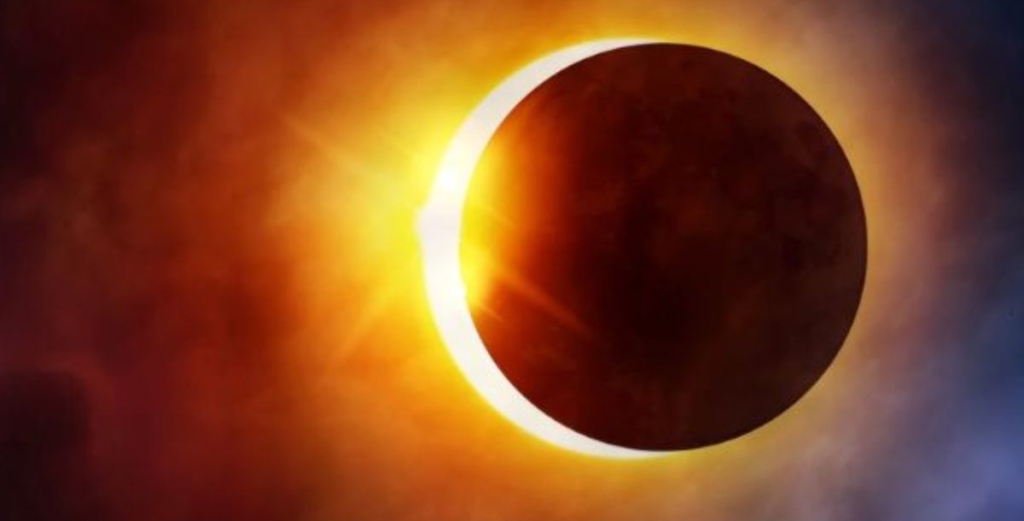
- Date: Wednesday, 12 August 2026 Instituto Geográfico Nacional
- Maximum Totality Duration: 2 minutes and 18 seconds (off the northwestern coast of Iceland) Astronomía IGN
- Path of Totality: Parts of northern Russia, eastern Greenland, western Iceland, northern and eastern Spain, and a small border area of northeastern Portugal. Instituto Geográfico Nacional
- Partial Eclipse Region: Most of Europe, parts of eastern North America, North Africa, the Atlantic, and the Arctic. NASA (.gov)
- Crucial Viewing Requirement: A completely unobstructed view of the western horizon, especially in Spain where the Sun will sit very low. Astronomía IGN
The Mechanics of a Celestial Alignment
A solar eclipse feels like magic, but it is rooted in celestial geometry. It happens when the Moon slides directly between Earth and the Sun, casting its shadow across the planet’s surfact
If the Moon orbits Earth every month, why don’t we get a solar eclipse during every new Moon? The answer lies in a minor tilt. The Moon’s orbit around Earth is inclined by about five degrees relative to Earth’s orbit around the Sun. Most of the time, the Moon passes slightly above or slightly below the Sun from our vantage point. An eclipse can only happen when the timing aligns perfectly at the points where these two orbital planes intersect.
The faint, shimmering solar corona. Source: Space
During a total eclipse, two distinct shadow regions sweep across Earth:
- The Umbra: The dark, inner cone of the Moon’s shadow. If you are inside the umbra, the Moon completely blocks the Sun’s glaring surface—the photosphere—revealing the faint outer atmosphere. NASA (.gov)
- The Penumbra: The lighter, much larger outer shadow. Observers in the penumbra see the Moon take a partial bite out of the solar disc. NASA (.gov)+ 1
A Remarkable Cosmic Coincidence
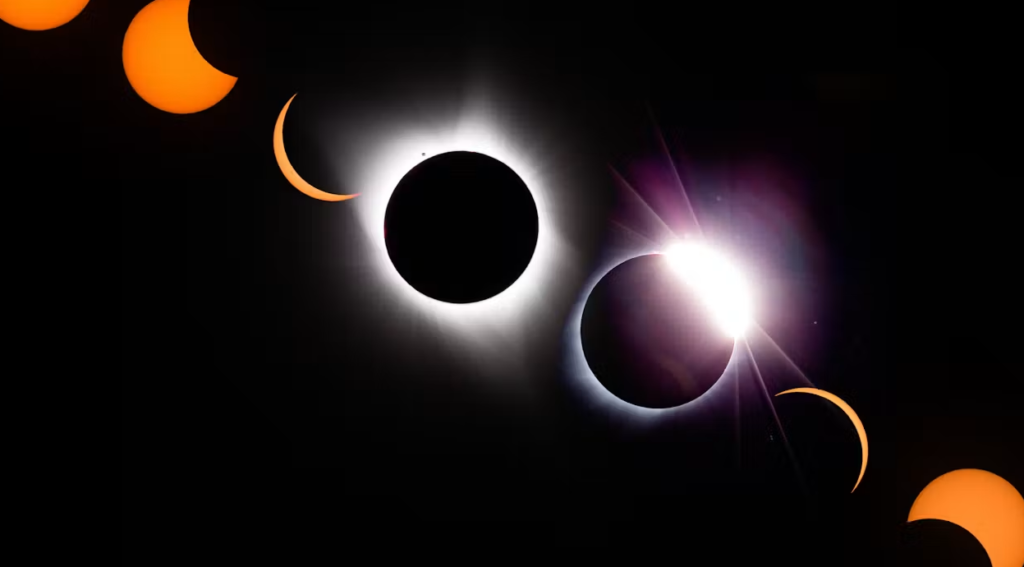
There is an astonishing mathematical coincidence behind what makes totality possible. The Sun is approximately 400 times wider than the Moon, but it is also roughly 400 times farther away. Because of this proportional balance, both objects appear virtually identical in size when viewed from Earth’s surface.
The Guardian
This cosmic symmetry won’t last forever. The Moon is slowly spiraling away from Earth at a rate of roughly 3.8 centimeters per year. Millions of years in the future, the Moon will appear too small in the sky to completely cover the Sun, bringing an end to total solar eclipses on Earth. We happen to live during a favored epoch in Earth’s history.
What Makes the 2026 Eclipse So Special?
For mainland Europe, this eclipse represents a generational milestone: it is the first total solar eclipse visible from mainland Europe since 1999.
The Economic Times
Spain serves as the main landmass for viewing, with the path cutting through major cities including A Coruña, Oviedo, León, Bilbao, Zaragoza, and Valencia, before reaching the Balearic Islands.
Instituto Geográfico Nacional
What makes Spain particularly interesting—and challenging—is the timing. The eclipse takes place in the late evening as the Sun descends toward the western horizon.
Instituto Geográfico Nacional+ 1
- In A Coruña (Galicia): Totality lasts about 76 seconds with the Sun positioned 12 degrees above the horizon. Astronomía IGN
- In Burgos (Castile and León): Totality stretches to roughly 104 seconds, but the Sun sits lower, at just 8 degrees. Astronomía IGN
- In Palma de Mallorca: Totality occurs when the Sun is barely 2 degrees above the horizon, just moments before sunset. Astronomía IGN
A Sun sitting low on the horizon introduces potential obstacles. A distant hill, line of trees, or tall building could easily block your view. On the other hand, this low solar elevation offers photographers a rare gift: the opportunity to capture the blacked-out Sun framed against dramatic earthly landscapes rather than high in an empty sky.
Astronomía IGN+ 1
Spain vs. Iceland: A Strategic Choice
Iceland offers another major land location, with Reykjavík sitting inside the path of totality. In Iceland, the Sun will sit noticeably higher in the sky than in Spain, making horizon obstacles less of a concern.
The Guardian+ 1
However, Iceland’s maritime weather is famously fickle. Spain offers historically drier and clearer August weather, making it the preferred choice for many travelers, provided they scout out an open view toward the west.
The Guardian+ 1
Why Eclipses Come in Pairs
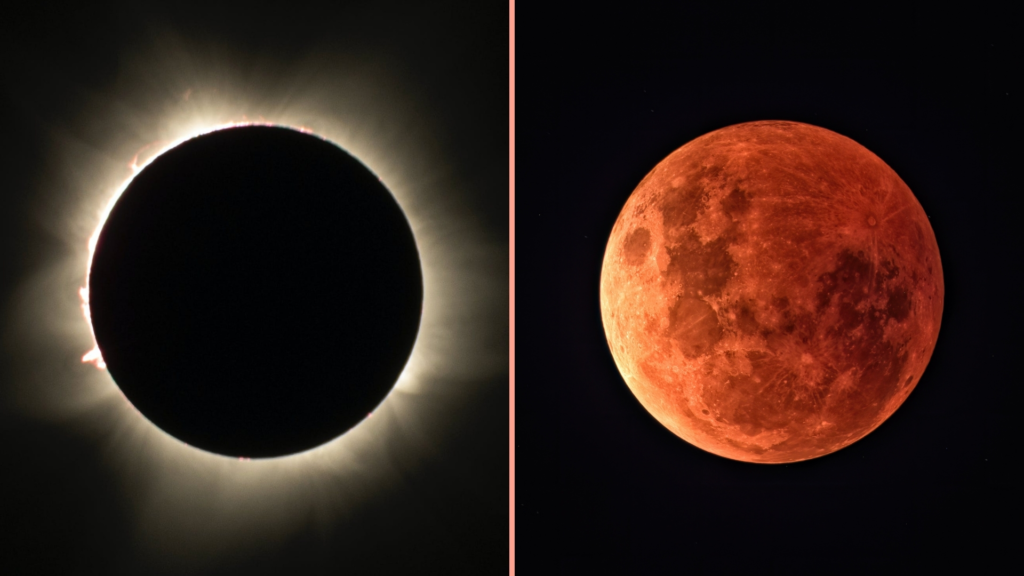
Eclipses rarely happen alone; they arrive in clusters during “eclipse seasons” that recur roughly every 173 days (just under six months).
An eclipse season lasts about five weeks, during which the Sun stays close enough to the lunar nodes (the intersection points of the orbits) for eclipses to take place. Because the cycle from a new Moon to a full Moon takes two weeks, a solar eclipse at new Moon is almost always accompanied by a lunar eclipse two weeks earlier or later.
Time Magazine
This exact cycle plays out in August 2026:
- 12 August 2026: Total Solar Eclipse (New Moon) Time Magazine
- 28 August 2026: Partial Lunar Eclipse (Full Moon)
While a solar eclipse is visible only along a narrow geographic strip swept by the Moon’s shadow, a lunar eclipse can be watched from anywhere on Earth’s night side. They are two sides of the same orbital alignment.
The Economic Times
The View from the UK and Ireland
While the UK and Ireland lie outside the path of totality, they will experience a deep partial solar eclipse—one of the deepest in decades.
Time Magazine
In London, the eclipse begins around 18:17 BST, reaches its maximum at 19:13 BST, and concludes near 20:06 BST. Across much of Britain, more than 90% of the Sun’s visible surface will be blocked, turning the Sun into a slender crescent. In southwestern parts of England, coverage will exceed 92%.
The Economic Times
It is worth noting that even a 95% partial eclipse feels different from totality. The remaining sliver of exposed Sun is blindingly bright. Daylight will dim into an eerie dusk-like hue, but the ambient light remains far brighter than during totality, and the solar corona will stay hidden.
The Guardian
Viewing Safety: Protecting Your Sight
Observing a solar eclipse is simple and safe as long as you follow basic optical rules.
NSO – National Solar Observatory
| Viewing Method | Direct Naked Eye | Cameras, Telescopes, & Binoculars |
|---|---|---|
| Partial Phases | Must use ISO 12312-2 certified eclipse glasses. Standard sunglasses are not safe. | Must use dedicated solar filters fitted over the front aperture of the lens. |
| Totality (100% block only) | Glasses can be safely removed to view the corona. | Filters can be briefly removed only during total coverage. |
Critical Safety Warning: Never look through a camera, telescope, or pair of binoculars while wearing regular eclipse glasses. The concentrated sunlight from the optical lenses will burn straight through the filter material and cause permanent eye injury.
If you don’t have eclipse glasses, indirect projection works as an alternative. A simple pinhole in a piece of card will project an image of the eclipsed Sun onto the ground. You can also look under leafy trees—the small gaps between leaves act as natural pinhole lenses, scattering hundreds of crescent-shaped light patterns across the group
Beyond the Sun: What Else to Expect
The most memorable moments of a total solar eclipse often happen away from the Sun itself:
The Economic Times
- Baily’s Beads & The Diamond Ring: Seconds before totality, the last rays of sunlight stream through valleys along the Moon’s jagged edge, creating bright points of light called Baily’s beads, followed by a single flash of light known as the diamond ring.
- The Atmospheric Drop: As sunlight wanes, ambient air temperatures can drop noticeably within minutes, accompanied by shifts in wind speed and direction.
- Nature’s Response: Birds often return to their nests, crickets begin chirping, and flowers close their petals as animals react to the sudden dark. The Economic Times
- 360-Degree Sunset Glow: Because totality covers a narrow region, looking toward the distant horizon reveals a 360-degree twilight glow where areas outside the shadow are still receiving sunlight. The Guardian
Whether you plan to travel to the coastal hills of northern Spain or watch from a park in Britain, August 12, 2026 offers a memorable opportunity to connect with the mechanics of our solar system.
Instituto Geográfico NacionalWould you like specific eclipse timing and totality details for a particular Spanish city or UK location?Yes
FAQ’s
1. When is the Solar Eclipse in 2026?
There are two solar eclipses in 2026, occurring in February and August.
2. Where will the 2026 solar eclipses be visible?
Visibility depends on the specific eclipse, with different regions experiencing partial or total phases.
3. Is the 2026 solar eclipse visible from India?
Visibility varies by eclipse and location. Check official astronomy sources for local visibility details.
4. Can I look directly at a solar eclipse?
No. Always use certified solar viewing glasses or appropriate solar-viewing equipment.
5. Why are solar eclipses important?
Solar eclipses provide valuable opportunities for astronomy, scientific observation, and public education.