
For a long time, the biggest bottleneck in science wasn’t a lack of good ideas—it was the sheer volume of grunt work. A scientist could spend an entire career testing a few hundred chemical compounds or manually combing through thousands of genetic sequences.
Complex protein structures predicted by machine learning models.. Source: Christoph Burgstedt / Getty Images
The future lab isn’t just full of test tubes; it’s powered by code that automates the trial-and-error, leaving humans free to do what they do best: ask the right questions. Instead of spending months physically pipetting liquids to see how a virus reacts to a specific chemical structure, a researcher can run millions of simulated combinations overnight. The software flags the top three candidates that have the highest probability of working, allowing the human scientist to step in exactly where critical thinking and intuition are needed most.
This shift moves us from a world of accidental discovery—where things like penicillin were found by chance because a petri dish was left out—to an era of intentional design. We are transitioning toward fully automated, closed-loop laboratories. In these environments, an AI proposes a chemical hypothesis, robotic arms physically mix the compounds, sensors read the outcome, and the AI uses that data to adjust its next experiment instantly.
Medicine Built for Your DNA, Not the Average
If you’ve ever taken a medication that worked perfectly for a friend but gave you nothing but side effects, you’ve experienced the limits of “one-size-fits-all” medicine. Historically, treatments were designed for the statistical average human. Because clinical trials looked at how a broad group reacted on average, the nuances of your unique biological makeup were essentially ironed out.
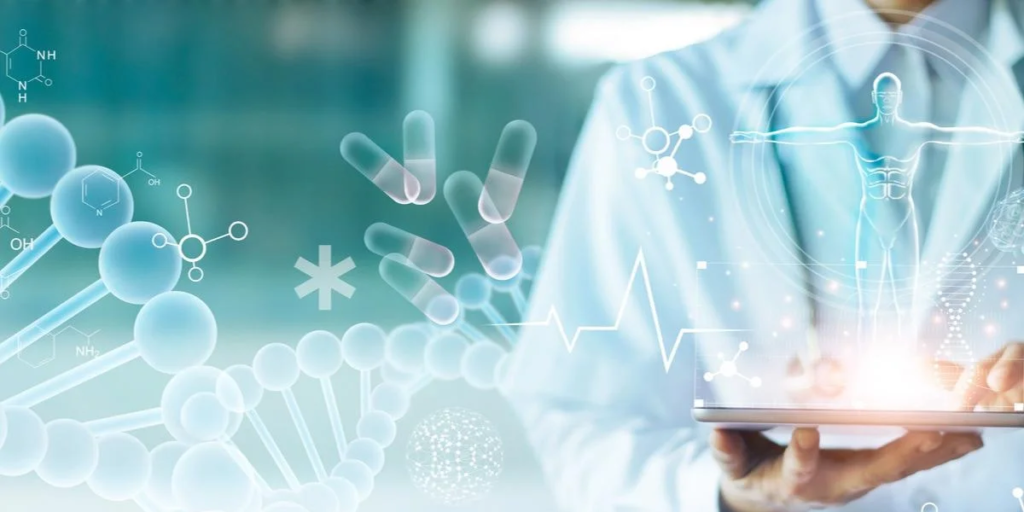
Mapping individual genetic variations to customize medical treatments.. Source: Nobi_Prizue / Getty Images
The Toolkit of Personalized Health
- Gene Editing: Think of it like a highly precise find-and-replace tool for your genetic code. Technologies like CRISPR are moving out of theoretical research labs and into active clinical trials, fixing cellular typos before they can ever develop into inherited conditions like sickle cell anemia or muscular dystrophy.
- Predictive Diagnostics: The next step beyond basic fitness trackers involves medical-grade wearables and smart sensors. By tracking subtle shifts in bio-metrics like resting heart rate variability, skin temperature, and blood oxygen levels in real time, these devices can catch warning signs of infection or cardiovascular stress weeks before you feel physical symptoms.
- Tailored Therapies: Oncology is seeing some of the most dramatic shifts. Instead of blasting a patient’s entire body with generic chemotherapy, doctors can sequence the exact genetic mutation driving a specific tumor. They then mix a targeted chemical cocktail or re-engineer the patient’s own immune cells to recognize and destroy that specific cancer without harming surrounding healthy tissue.
The New Horizon: From Outer Space to the Quantum Realm
It is a fascinating paradox: at the exact moment we are building telescopes to look billions of years back into the deep cosmos, we are also looking inward at subatomic particles to build the next generation of computing architecture.
Space Travel Gets Gritty

We’ve moved past the era where space exploration was purely a symbolic race between superpowers. Today, the push toward orbit, the Moon, and eventually Mars is fundamentally about building scalable logistics and heavy infrastructure.
Private enterprises and public space agencies are treating orbit as a real economic ecosystem. They are developing long-term automated habitats, active planetary defense systems to spot near-Earth asteroids, and hyper-dense satellite constellations. These networks don’t just provide internet; they house advanced imaging sensors that keep our ground-level climate models accurate by measuring ocean temperatures and atmospheric changes down to the millimeter.
The Quantum Leap
Traditional computers, no matter how fast or powerful, still process data sequentially by flipping billions of microscopic switches between 0 and 1. If you give a standard supercomputer a maze with millions of paths, it will solve it by testing every single route one after another at blazing speed.
Quantum computing discards this approach entirely. By leveraging the bizarre properties of quantum mechanics—like superposition, which allows a quantum bit, or qubit, to exist as both a 0 and a 1 simultaneously—a quantum machine can evaluate every single path through that maze all at the exact same time.
For the average person, this isn’t about making your web browser load faster or your video games smoother. It is about unlocking the computing power required to simulate the physical universe at a molecular level. A quantum computer can simulate how atoms interact perfectly, allowing us to discover super-strong, lightweight materials, create completely unhackable cryptographic keys, and calculate complex environmental interactions that are mathematically impossible for standard computers to compute.
Redesigning Earthly Essentials: Energy and Biotech

While some scientists look at the deep space horizon, others are focused entirely on fixing the ground beneath our feet. The reality of climate change has forced a radical shift in how we approach resource management.
The Big Shift: We are moving away from simply trying to perform “damage control” on our carbon footprint, and moving toward engineering entirely closed-loop, sustainable biological systems.
In the energy sector, the conversation has progressed past simply manufacturing more solar panels or wind turbines. The core challenge now is grid stability and energy storage. Because the sun doesn’t always shine and the wind doesn’t always blow, scientists are investing heavily in mastering grid-scale battery storage, solid-state batteries, and hydrogen fuel cells. The goal is to build an adaptable grid that can store massive amounts of clean power during peak production hours and distribute it seamlessly when production drops.
Meanwhile, biotechnology is quietly changing the texture of our physical world. The line between traditional farming and industrial manufacturing is beginning to blur into a new field: bio-manufacturing.
| Biotech Innovation | How It Works | Real-World Impact |
|---|---|---|
| Climate-Resilient Crops | Editing plant genomes to naturally handle extreme weather. | Crops that thrive in severe droughts or high-salinity soil without requiring chemical pesticides. |
| Cellular Agriculture | Cultivating real animal protein directly from cells in a bioreactor. | Lab-grown meat that provides genuine nutrition while using a fraction of the land and water required for livestock. |
| Mycelium Materials | Growing structural items using the root networks of fungi. | Creating strong, biodegradable alternatives to plastics and styrofoam that dissolve back into soil in weeks. |
The Human Elements: Ethics, Grit, and Connection

All of this machinery, robotics, and advanced code means absolutely nothing without the human intent behind it. If the global challenges of the last few decades have proven anything, it is that breakthrough science cannot happen in a vacuum. The most impactful discoveries occur when a laboratory in Tokyo shares its raw data instantly with an epidemiology team in Munich, allowing different perspectives to click together.
However, the accelerating speed of this progress brings heavy, unavoidable ethical questions that tech alone cannot resolve:
- Regulation: How do we create global frameworks for gene editing to ensure it is used to treat debilitating diseases rather than create genetic inequality?
- Privacy: In an era where healthcare is driven entirely by data, who owns your genetic profile, and how do we protect it from being weaponized by insurance algorithms?
- Trust: How do we combat the rapid spread of sophisticated misinformation online when complex scientific consensus takes time to build, but a false headline can go viral in seconds?
The skill sets required for the next generation of thinkers are shifting. The future doesn’t just belong to those who know how to write code or isolate a biological cell in a cleanroom. It belongs to those who can connect the dots—individuals who can combine technical data analysis with deep ethical reasoning, empathy, and the communication skills needed to explain these monumental changes to a world that is anxious about the future. Science is moving exceptionally fast, but its ultimate goal remains entirely human: to make our lives a little less fragile, and the universe a little more understood.
FAQs
1. What is the future of science?
The future of science focuses on innovations that improve healthcare, technology, energy, and space exploration.
2. How is AI helping science?
AI speeds up research, analyzes data, and supports faster discoveries.
3. What is personalized medicine?
It is healthcare tailored to a person’s genes and medical needs.
4. Why is renewable energy important?
It helps reduce pollution and creates a more sustainable future.
5. What are the biggest future scientific breakthroughs?
AI, quantum computing, biotechnology, renewable energy, and space exploration are expected to lead the way.