
The universe has sent us another cosmic messenger. Interstellar Comet 3I/ATLAS has entered our solar system, instantly becoming one of the rarest astronomical discoveries ever recorded. Scientists, space agencies, and skywatchers around the world are watching closely—because objects like this don’t come around often… if ever again in our lifetime.
So, what exactly is 3I/ATLAS, and why is the scientific community buzzing with excitement? Let’s break it down in a clear, engaging way.
What Is Interstellar Comet 3I/ATLAS?
Interstellar Comet 3I/ATLAS is only the third known object ever detected that originated outside our solar system and traveled through it. Unlike regular comets that orbit the Sun, this one comes from another star system entirely.
It was discovered by the ATLAS (Asteroid Terrestrial-impact Last Alert System), a powerful sky survey program funded by NASA and operated by the University of Hawaiʻi.
What immediately caught astronomers’ attention was its hyperbolic trajectory—a clear sign that it is not gravitationally bound to the Sun.
Why 3I/ATLAS Is So Rare
1. Only the Third Interstellar Visitor Ever Found
Before 3I/ATLAS, scientists confirmed only two interstellar objects:
- ‘Oumuamua (2017) – mysterious and asteroid-like
- 2I/Borisov (2019) – the first confirmed interstellar comet
That means 3I/ATLAS is an exceptionally rare cosmic event—a once-in-a-generation discovery.
2. It Came From Another Star System
Most comets form in the Kuiper Belt or Oort Cloud. But 3I/ATLAS was born around a completely different star, possibly millions or billions of years ago.
This makes it a natural sample of alien planetary material, offering insights we could never obtain otherwise.
3. Extreme Speed and Unusual Orbit
3I/ATLAS is traveling at extraordinary speed, far faster than typical solar system comets. Its sharply curved path confirms it is:
- Not orbiting the Sun
- Not returning
- Simply passing through before disappearing forever
Once it leaves, we may never see it again.
What Scientists Are Studying Right Now
Astronomers are racing against time to gather as much data as possible using ground-based telescopes and space observatories.
They are analyzing:
- Chemical composition
- Gas and dust emissions
- Surface reflectivity
- Coma and tail behavior
This research may help answer one of astronomy’s biggest questions:
Are the building blocks of planets the same across the galaxy?
Why Interstellar Comets Matter So Much
Interstellar objects are cosmic time capsules. They preserve untouched material from distant star systems, giving scientists a rare chance to:
- Compare planetary formation beyond our solar system
- Understand how common life-friendly chemistry might be
- Improve detection methods for future interstellar visitors
According to researchers collaborating with organizations like European Space Agency, each discovery like this refines our understanding of the galaxy.
Can You See 3I/ATLAS From Earth?
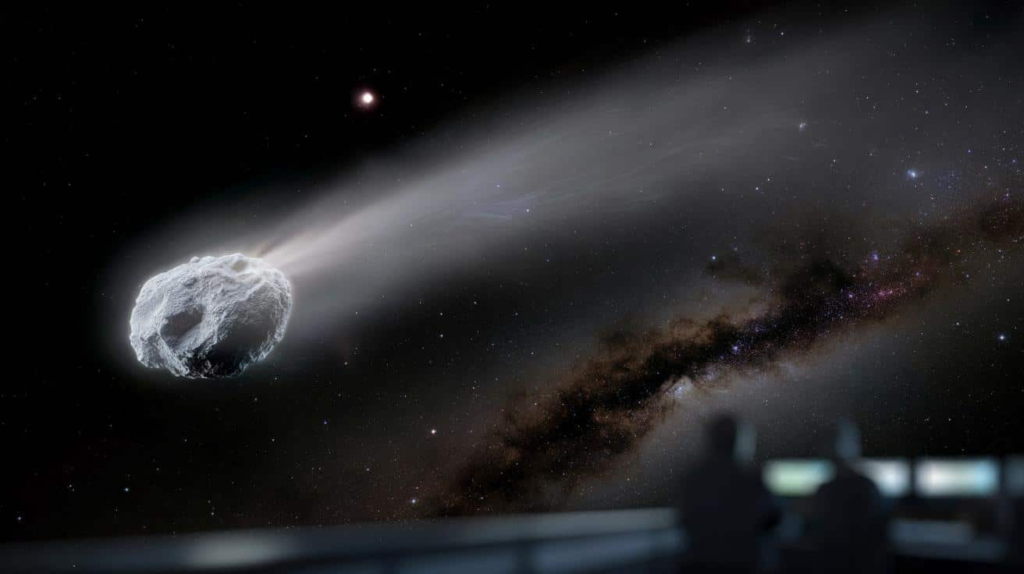
For most casual skywatchers, 3I/ATLAS is faint and difficult to observe without professional telescopes. However:
- Large observatories can track it clearly
- Data will continue to be shared publicly
- Future technology may allow better detection of similar objects
Even if you can’t see it directly, its scientific impact is enormous.
How This Discovery Changes Space Science
3I/ATLAS proves that interstellar objects are more common than once believed—we just didn’t have the tools to spot them.
With next-generation observatories like the Vera C. Rubin Observatory, scientists expect to detect many more interstellar visitors in the coming years.
This could mark the beginning of a new era in astronomy, where studying objects from other star systems becomes routine rather than extraordinary.
A Visitor From the Stars
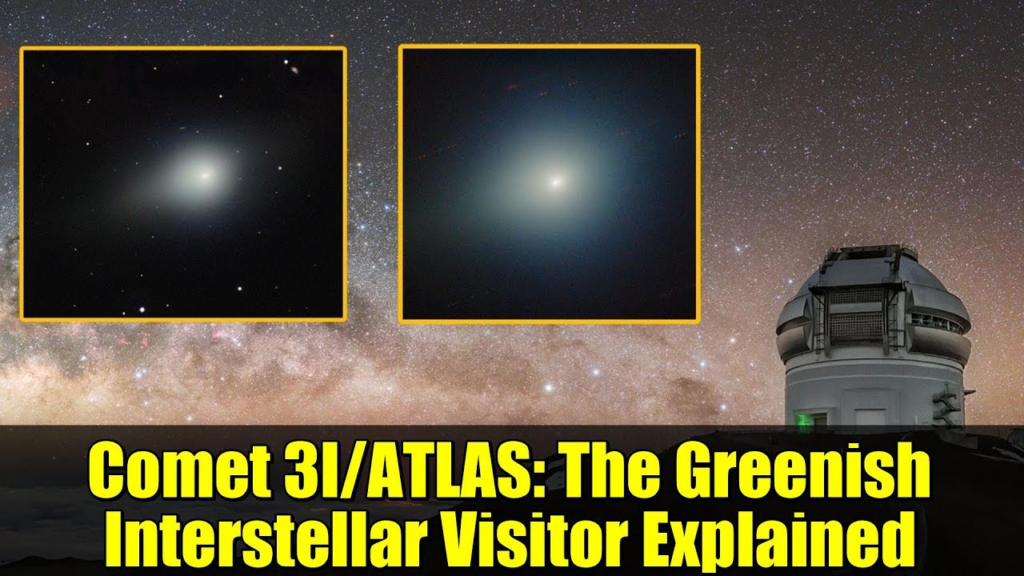
Interstellar Comet 3I/ATLAS isn’t just a comet—it’s a galactic traveler, a messenger from a distant star system carrying secrets older than Earth itself.
Its rarity, origin, and fleeting presence make it one of the most exciting space discoveries of our time. As it speeds away into the darkness, it leaves behind new knowledge—and a reminder of how vast and mysterious our universe truly is.
| Update Category | Latest Information |
|---|---|
| Closest Approach | Scheduled for December 19, 2025, passing about 1.8 AU (~170 million miles / ~270 million km) from Earth — no threat to Earth. TechStock² |
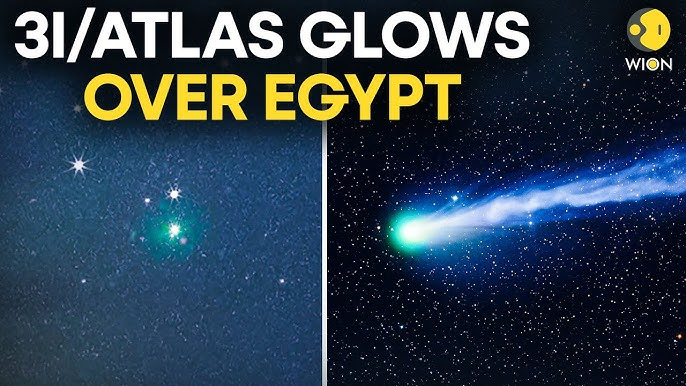
| Brightness & Appearance | The comet is brightening and showing a distinct green glow due to increased gas and dust activity. TechStock² |
| Scientific Observations | ESA’s XMM-Newton detected X-ray emissions from 3I/ATLAS, offering new data on its interaction with solar wind. esa.int |
| Cometary Behavior | Recent studies confirm typical outgassing (gas and dust emission), consistent with comet activity. Chron |
| Physical Position & Brightness | Current observed magnitude ~11.4; position coordinates updated for sky trackers. The Sky Live |
| Scientific Campaigns | Global monitoring by space agencies and networks (NASA, ESA, and UN International Asteroid Warning Network) continues to refine its trajectory and properties. Live Science |
| Research Highlights | Ongoing analysis of gas composition, dust production, tail structure, and activity patterns as 3I/ATLAS passes through the inner solar system. Space |
#InterstellarComet #3IATLAS #SpaceDiscovery #AstronomyNews #CosmicMystery #NASA #DeepSpace #UniverseExplained